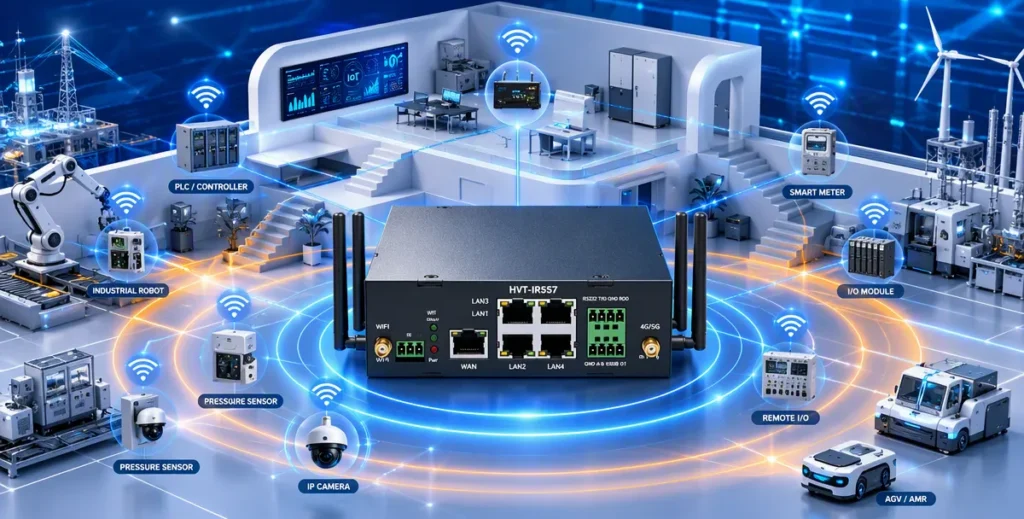
Modern smart factories need reliable wireless connectivity for Automated Guided Vehicles (AGVs), Autonomous Mobile Robots (AMRs), PLCs, CNC machines, industrial cameras, and edge AI systems. Yet many plants still face the same challenge: wired Ethernet is difficult to extend across moving equipment, Wi‑Fi can be affected by metal structures and electromagnetic interference, LTE may not meet future capacity requirements, and full-featured 5G eMBB hardware can be excessive for many Industrial IoT applications.
An industrial 5G RedCap router helps fill this gap. Designed for mid-tier Industrial IoT connectivity, 5G RedCap provides a practical balance between LTE-class cost efficiency and 5G Standalone (SA) network capabilities.
For factories deploying AGVs, AI vision systems, PLC monitoring, or private 5G networks, RedCap can provide a scalable wireless option—provided the network, spectrum, coverage, edge architecture, and hardware interfaces are validated for the specific project.
Need help selecting an industrial 5G RedCap router?
Request a Factory Connectivity Assessment or speak with a HoweVis industrial networking specialist about your AGV, AI vision, PLC, or private 5G project.
Request AssessmentWhat Is a 5G RedCap Industrial Router?
5G RedCap, short for Reduced Capability, is a 5G device category introduced in 3GPP Release 17. It is also known as NR-Light.
RedCap was developed for devices that require more capability than low-speed IoT technologies, but do not need the full bandwidth, antenna complexity, power consumption, or cost of conventional 5G eMBB devices.

A 5G RedCap industrial router connects field equipment—such as PLCs, cameras, AGVs, sensors, industrial PCs, and CNC machines—to a 5G Standalone network, private 5G network, or compatible cellular infrastructure.
Compared with full 5G devices, RedCap reduces modem complexity through narrower bandwidth support and fewer antenna branches. Under the 3GPP Release 17 RedCap framework, the simplified design can support up to 20 MHz bandwidth in relevant configurations, while reducing device complexity compared with conventional 5G NR equipment. Learn more about 5G RedCap and Release 17 from 3GPP.
For industrial deployments, the main value is not simply peak speed. It is the ability to use a lower-complexity 5G endpoint within a 5G SA or private 5G architecture.
5G RedCap vs. 4G LTE vs. Full 5G
Factories should select wireless technology based on actual device requirements, network readiness, deployment conditions, and lifecycle planning—not headline data-rate claims alone.
| Category | 4G LTE Cat 4 | 5G RedCap | Full 5G eMBB |
|---|---|---|---|
| Best fit | General legacy cellular data and standard IoT | Mid-tier industrial IoT, AGVs, gateways, cameras, monitoring | High-throughput broadband and advanced 5G workloads |
| Device complexity | Lower | Reduced compared with conventional 5G | Highest |
| Network generation | LTE | 5G Standalone ecosystem | 5G Standalone or Non-Standalone ecosystem |
| Peak throughput potential | Deployment-dependent | Up to 226 Mbps downlink / 120 Mbps uplink theoretical peak | Potentially much higher depending on spectrum and network configuration |
| Radio bandwidth | LTE carrier dependent | Reduced bandwidth design | Wider channel bandwidth support |
| Power and thermal requirements | Typically lower | Lower than many full 5G devices | Often higher |
| Suitable for private 5G | Limited by deployment model | Yes, when compatible with the private 5G SA network | Yes |
| Typical industrial use | Remote monitoring, basic telemetry, legacy equipment | AGVs, PLC gateways, moderate video, machine monitoring, edge devices | High-capacity video, advanced applications, demanding broadband workloads |
A key consideration is that RedCap is a device capability category, not a guaranteed performance outcome. Actual uplink throughput, latency, roaming performance, and reliability depend on factors such as:
- 5G SA network availability
- Private or public 5G spectrum
- Local coverage and signal quality
- Antenna placement and cable loss
- Network loading
- QoS policies
- 5G core architecture
- MEC or edge-computing location
- Router hardware and firmware
- Application traffic profile
For example, a compressed 1080p camera stream may be a suitable RedCap workload, while multiple uncompressed high-frame-rate industrial cameras may require more uplink capacity, dedicated spectrum, local processing, or wired Ethernet/fiber connectivity.
Why Smart Factories Need Industrial 5G RedCap Gateways
Industrial environments are different from offices, warehouses, and public Wi‑Fi spaces. Wireless equipment must operate around moving vehicles, welding areas, electric motors, metal racks, robotic arms, VFDs, dust, heat, vibration, and dense machine layouts.
A properly designed industrial 5G RedCap gateway can support a more flexible connectivity layer between field devices and factory applications.
Common Factory Connectivity Challenges
- Metal shielding and multipath interference: Metal equipment, storage racks, production cells, and machine housings can affect wireless propagation and create difficult RF conditions.
- Wi‑Fi roaming limitations: Mobile AGVs and AMRs may experience service disruption when moving between access-point coverage zones if roaming is not engineered and validated for the application.
- Cabling complexity: Ethernet cabling to moving robots, mobile carts, robotic arms, or expanding production cells can increase installation time and maintenance requirements.
- Legacy machine connectivity gaps: Older PLCs and CNC systems may use RS‑232, RS‑485, Modbus RTU, or basic Ethernet interfaces rather than modern cloud-ready protocols.
- Uplink-heavy data workloads: Industrial cameras, inspection stations, and edge devices can generate significant uplink traffic.
- Network lifecycle planning: New industrial projects should assess local carrier and spectrum roadmaps before committing to a long-term connectivity technology.
5G RedCap is especially relevant when the factory needs a lower-complexity 5G endpoint for industrial devices, but does not require full eMBB capacity at every node.
5G RedCap Router Applications for AGVs, AI Vision, and PLCs
AGV and AMR Fleet Connectivity
AGVs and AMRs need continuous connectivity for dispatch instructions, diagnostics, fleet management, navigation updates, telemetry, and integration with warehouse or manufacturing execution systems.

An industrial 5G RedCap router can be installed inside an AGV chassis or vehicle control enclosure to provide cellular or private 5G connectivity for Ethernet, serial, or onboard computing devices.
A RedCap-based design may be suitable for:
- AGV fleet dispatch and route updates
- Vehicle telemetry and battery monitoring
- Warehouse management system integration
- Remote diagnostics and OTA maintenance workflows
- Onboard camera or sensor data transfer
- Multi-site mobile equipment monitoring
However, safety-critical motion behavior must not depend solely on wireless connectivity. AGV systems should include local fail-safe logic, validated stop behavior, and a defined communications-loss strategy.
Before deployment, test coverage and handover performance along the actual vehicle route, including intersections, welding zones, loading areas, narrow aisles, elevator transitions, metal shelves, and high-interference production cells.
Explore industrial wireless routers for AGV and mobile equipment connectivity →
AI Vision and Industrial Camera Backhaul
Industrial AI vision systems depend on stable transport for camera images, compressed video streams, inspection results, alarms, and data exchanged with edge AI servers.
A 5G RedCap industrial router may support machine-vision connectivity where the bandwidth requirement fits the available uplink capacity and radio conditions. It can be particularly useful for flexible production cells, robotic arms, mobile inspection stations, or locations where cabling is difficult to install or maintain.
Typical use cases include:
- Automated optical inspection (AOI)
- Quality inspection stations
- Packaging-line image capture
- Mobile visual inspection systems
- Robotic-arm cameras
- Remote video diagnostics
- Edge AI defect-detection workflows
For industrial camera projects, calculate bandwidth requirements before selecting the router. Consider:
- Camera resolution
- Frames per second
- Compression type
- Bit rate
- Number of simultaneous camera streams
- Protocol overhead
- Peak production load
- Edge server location
- Required storage and retention policy
A router with Gigabit Ethernet and PoE/PoE+ capabilities can simplify deployment by combining camera power and data connectivity at the workcell. Verify the device’s total PoE power budget, per-port output, thermal behavior, and uplink capacity before connecting multiple cameras.
View HoweVis industrial PoE+ router options for camera and vision workcells →
Planning an AI vision deployment?
Request a network design review to evaluate camera count, PoE budget, uplink demand, antenna placement, and edge-computing topology.
Request Design ReviewPLC and CNC Machine Retrofitting
Many factories operate valuable legacy machinery that has limited connectivity. A CNC machine, press, packaging line, or PLC cabinet may only support serial communication, Modbus RTU, Modbus TCP, or a basic Ethernet interface.
An industrial 5G RedCap gateway can help connect these assets to an industrial data platform without requiring major changes to the original machine control system.
Potential applications include:
- PLC data collection
- CNC status monitoring
- Vibration and temperature monitoring
- Energy consumption monitoring
- Predictive-maintenance data collection
- Remote troubleshooting
- Machine alarm notification
- MES, SCADA, or historian integration
For these projects, confirm that the gateway supports the actual industrial protocols in use. Typical requirements may include RS‑232, RS‑485, Modbus RTU, Modbus TCP, MQTT, OPC UA, or other industrial communication methods.
HoweVis states that its HVT-IR93XX gateway series supports protocol conversion functions involving Modbus TCP, Modbus RTU, EtherNet/IP, and MQTT. Buyers should validate the exact model, firmware version, protocol role, supported conversion logic, security configuration, and compatibility with the actual PLC or CNC environment before project deployment.
Explore industrial gateways for PLC and CNC machine connectivity →
How to Choose an Industrial 5G RedCap Gateway
Selecting the best industrial 5G RedCap router requires more than comparing cellular speed specifications. Procurement teams, system integrators, OT engineers, and IT managers should evaluate the complete deployment environment.
1. Confirm 5G SA and RedCap Network Compatibility
Before purchasing hardware, confirm that the intended network supports RedCap and 5G Standalone operation.
Ask your carrier, private-network provider, or system integrator:
- Is 5G RedCap commercially available in the target factory location?
- Does the network operate on 5G Standalone architecture?
- Which 5G frequency bands are supported?
- Does the router support the local bands and carrier profiles?
- Is private 5G spectrum available for the project?
- What uplink capacity is available under production conditions?
- Can the network provide traffic prioritization or QoS policies?
- Is local breakout or MEC available for latency-sensitive applications?
- Will mobile assets require domestic or international roaming support?
Do not assume that all 5G networks automatically support RedCap. Confirm compatibility before finalizing router selection or project budgeting.
2. Match Router Throughput to the Application
Theoretical peak data rates should not be used as the only sizing method.
| Application | Typical RedCap Suitability | What to Validate |
|---|---|---|
| PLC telemetry and alarms | Strong fit | Protocol support, security, reliability, recovery behavior |
| Environmental monitoring | Strong fit | Coverage, power, sensor integration, data usage |
| Predictive maintenance | Strong fit | Sampling rate, storage, MQTT/OPC UA workflow |
| AGV fleet dispatch | Often suitable | Mobility, handover, vehicle route coverage, fail-safe design |
| Remote diagnostics | Often suitable | VPN, user access controls, remote-management policy |
| Compressed industrial camera streams | Potential fit | Uplink throughput, simultaneous streams, edge server location |
| High-frame-rate machine vision | Conditional | Image format, compression, frame rate, deterministic throughput needs |
| Raw multi-camera video | Often requires further evaluation | Uplink capacity, local MEC, spectrum, wired/fiber alternative |
| Hard real-time motion control | Requires specialized design | End-to-end deterministic networking validation |
3. Evaluate Industrial Interfaces and PoE Requirements
Industrial router interfaces determine how easily the device integrates into existing machines, control cabinets, and workcells.
Verify:
- Gigabit Ethernet LAN and WAN port count
- PoE or PoE+ output capability
- Total PoE power budget
- Per-port PoE output limit
- Serial port availability
- RS‑232 and RS‑485 support
- Serial isolation requirements
- Digital I/O requirements
- USB storage or expansion options
- DIN-rail, wall-mount, or vehicle-mount design
- Antenna connector type and antenna placement options
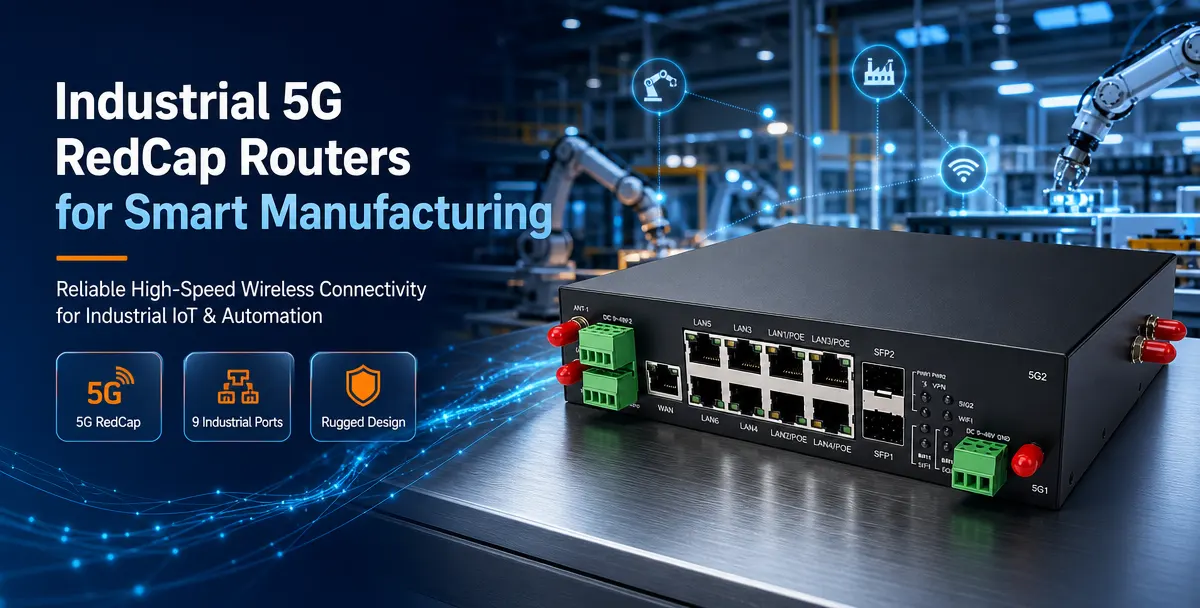
For camera-heavy applications, do not choose a router based only on the number of PoE ports. A 9-port PoE+ router may have a total output budget that limits the number or type of cameras it can power simultaneously. Always check the total power budget and expected camera consumption.
4. Build Network Redundancy into the Design
Network redundancy is important for remote assets, mobile equipment, distributed production cells, and mission-critical monitoring applications.
Look for:
- Dual SIM slots
- Automatic 5G/4G failover
- Wired WAN backup
- Multi-WAN routing
- Link-health monitoring
- Policy-based routing
- Automatic connection recovery
- Watchdog functionality
- Local data buffering where required
Dual SIM alone does not guarantee complete network resilience. If both SIM cards use the same carrier or local infrastructure, they may share the same RAN, backhaul, power, or core-network dependency. For high-availability applications, assess the actual independence of every backup path.
5. Validate VPN, Security, and Device Management
Industrial routers often bridge OT assets and enterprise networks. Security should be evaluated before deployment, not added after installation.
Key requirements may include:
- IPsec VPN
- OpenVPN
- WireGuard
- Secure remote access
- Firewall and access-control rules
- VLAN segmentation
- Certificate-based authentication
- Secure boot
- Signed firmware
- Role-based user access
- Remote monitoring
- Configuration backup
- Zero-touch provisioning
- Firmware-over-the-air updates
- Device inventory and audit logs
For factories with strict OT security policies, verify how remote cloud management is configured, where data is stored, who owns the management account, and how devices behave if cloud access becomes unavailable.
6. Check Environmental and Reliability Specifications
An industrial 5G RedCap router may be installed in a control cabinet, AGV enclosure, outdoor box, robotic cell, machine frame, or high-temperature production environment.
Confirm:
- Operating-temperature range
- Thermal derating requirements
- Fanless cooling design
- Vibration resistance
- Shock resistance
- EMC and EMI performance
- Power input range
- Surge protection
- Reverse-polarity protection
- Enclosure material
- IP rating, if required
- Certification requirements for the target market
Do not use a consumer-grade 5G router in a factory just because it has the desired cellular modem. Industrial environments require hardware designed for continuous operation, electrical noise, temperature variation, installation constraints, and remote maintenance.
Common 5G RedCap Deployment Mistakes to Avoid
- Assuming Every 5G Network Supports RedCap: 5G branding does not automatically mean that a public or private network supports RedCap. Confirm 5G SA availability, RedCap compatibility, bands, SIM profiles, local coverage, QoS options, and provider support before deployment.
- Sizing Camera Projects by Peak Speed Claims: Do not assume that theoretical RedCap speeds translate directly into available industrial camera capacity. Calculate actual uplink demand based on camera count, resolution, frame rate, compression, simultaneous traffic, protocol overhead, and peak production conditions.
- Treating RedCap as a Universal Replacement for Wired Control: RedCap can be effective for many industrial IoT and monitoring applications, but it should not automatically replace wired deterministic networks used for safety-critical or hard real-time motion control. These applications require end-to-end validation.
- Ignoring Radio Survey and Antenna Design: Industrial radio performance depends heavily on antenna location, cable length, metal obstructions, electromagnetic interference, production-line layout, vehicle movement, and coverage overlap. Conduct a radio survey and validate the real route or workcell environment before large-scale deployment.
- Assuming Dual SIM Provides Full Resilience: Two SIM cards may still depend on the same mobile network infrastructure. For mission-critical deployments, evaluate carrier diversity, backhaul diversity, power resilience, and core-network dependencies.
- Buying Hardware Before Checking Interfaces: Before choosing a router, confirm Ethernet port count, PoE budget, serial ports, voltage input, mounting method, protocol support, VPN requirements, and target-region cellular bands.
HoweVis Industrial 5G Router Solutions
HoweVis provides industrial wireless router solutions designed for factory automation, industrial IoT, remote equipment connectivity, AGV communication, camera networks, and control cabinet deployments.
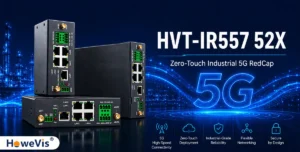
HVT-IR557-52X for AGVs and Compact Cabinets
The HoweVis HVT-IR557-52X series is positioned for compact industrial deployments where installation space is limited, including AGV chassis, mobile equipment, small control cabinets, and distributed field devices.
Potential project requirements include:
- Compact enclosure design
- 5G RedCap or cellular connectivity
- Dual-SIM redundancy
- Private 5G compatibility
- Ethernet connectivity
- VPN support
- Remote device management
- Industrial power input
- AGV or mobile-equipment installation
Before deployment, confirm the exact cellular module, supported 5G bands, temperature rating, SIM configuration, Ethernet interface count, and power specification for the selected model.
Explore HoweVis industrial wireless router solutions →
HVT-IR93XX for AI Vision and PoE Camera Workcells
The HoweVis HVT-IR93XX series is positioned for industrial applications that need multiple Gigabit Ethernet ports and PoE+ capability, such as AI inspection workcells, industrial camera networks, packaging lines, robotic cells, and distributed machine-vision stations.
Potential benefits include:
- Multiple Gigabit Ethernet ports
- PoE+ camera power delivery
- Reduced field wiring complexity
- Industrial network connectivity
- Support for protocol conversion and industrial data collection
- Flexible integration with cameras, industrial PCs, PLCs, and edge devices
Before selecting a model, verify the total PoE power budget, Ethernet switching capacity, thermal performance, actual 5G or RedCap module configuration, cellular band support, and expected number of simultaneous camera streams.
View HoweVis PoE+ industrial router options →
HVT-IR53XX for PLC, CNC, and Control Cabinet Connectivity
The HoweVis HVT-IR53XX series is positioned for industrial control cabinets, PLC connectivity, CNC retrofitting, industrial PCs, and multi-device Ethernet environments.
Typical use cases include:
- PLC data acquisition
- CNC remote monitoring
- Industrial Ethernet connectivity
- VPN-based remote maintenance
- Control cabinet network extension
- Machine data collection
- Secure access to industrial PCs and controllers
For a PLC or CNC project, verify protocol support, port configuration, VPN features, firewall capabilities, serial interface options, local logging, power input, and compatibility with the target machine network.
Explore industrial gateway solutions for PLC and CNC connectivity →
Request a 5G RedCap Router Datasheet or Factory Assessment
Every factory has different coverage, spectrum, application, protocol, interface, environmental, and cybersecurity requirements. The right industrial 5G RedCap router depends on the complete deployment scenario—not only the router’s advertised cellular speed.
Before selecting a model, prepare the following information:
- Factory country and operating region
- Public 5G or private 5G network type
- Required cellular frequency bands
- Number of AGVs, cameras, PLCs, CNC machines, or edge devices
- Required Ethernet, PoE, serial, and I/O interfaces
- Expected uplink and downlink traffic
- VPN and cybersecurity requirements
- Operating-temperature range
- Installation location and mounting method
- Estimated project quantity
- Required delivery schedule
- OEM, branding, or customization requirements
Build a more reliable industrial wireless network
Request a Custom 5G RedCap Solution Assessment to discuss router selection, 5G band compatibility, PoE requirements, protocol integration, redundancy design, and project pricing.
Request Custom Solution AssessmentFrequently Asked Questions (FAQ)
What is a 5G RedCap industrial router?
A 5G RedCap industrial router is a rugged cellular gateway designed to connect industrial equipment to 5G networks using the Reduced Capability, or RedCap, device category introduced in 3GPP Release 17. It is intended for mid-tier Industrial IoT applications that need more capability than basic cellular IoT devices but do not require full 5G eMBB performance.
Is 5G RedCap compatible with 4G LTE?
Many industrial cellular routers are designed with 5G and LTE fallback capabilities, but support depends on the exact router model, cellular module, firmware, carrier profile, and regional frequency bands. Confirm the supported 4G and 5G bands before purchasing.
Can a 5G RedCap router support AGVs and AMRs?
Yes, RedCap routers can be suitable for AGV and AMR connectivity, including fleet dispatch, telemetry, diagnostics, route updates, and integration with factory software. However, actual mobility performance depends on radio coverage, handover configuration, antenna design, vehicle route, 5G SA availability, and private-network architecture.
Can a 5G RedCap router support industrial cameras?
It can support selected camera and vision applications when the available uplink capacity matches the real traffic requirement. The number of cameras depends on resolution, frame rate, compression, bitrate, PoE budget, simultaneous streams, and the required edge-processing architecture.
Does 5G RedCap support private 5G networks?
RedCap can operate in a compatible 5G Standalone private-network environment. Buyers should confirm support with the private-network provider and verify spectrum bands, SIM/eSIM requirements, router compatibility, QoS configuration, and local edge-computing design.
What should I check before buying an industrial 5G RedCap gateway?
Check 5G SA and RedCap network compatibility, local bands, SIM options, Ethernet and serial interfaces, PoE budget, VPN support, protocol requirements, remote management, temperature rating, EMC performance, antenna requirements, installation method, and long-term maintenance plan.
How do I request a HoweVis industrial 5G router quotation?
Contact HoweVis with your application type, target country, carrier or private-network information, required frequency bands, device quantity, interface requirements, and project timeline. Providing these details helps the technical team recommend a suitable model and prepare an accurate quotation.
Next Step
5G RedCap provides a practical wireless path for industrial projects that need more than basic LTE connectivity but do not require full 5G eMBB performance at every endpoint. For AGV fleets, AI vision workcells, PLC/CNC retrofits, remote equipment monitoring, and private 5G deployments, the right solution begins with application validation and network design.
Explore HoweVis Industrial Wireless Router Solutions or request a custom factory connectivity assessment.