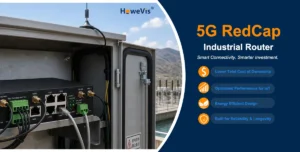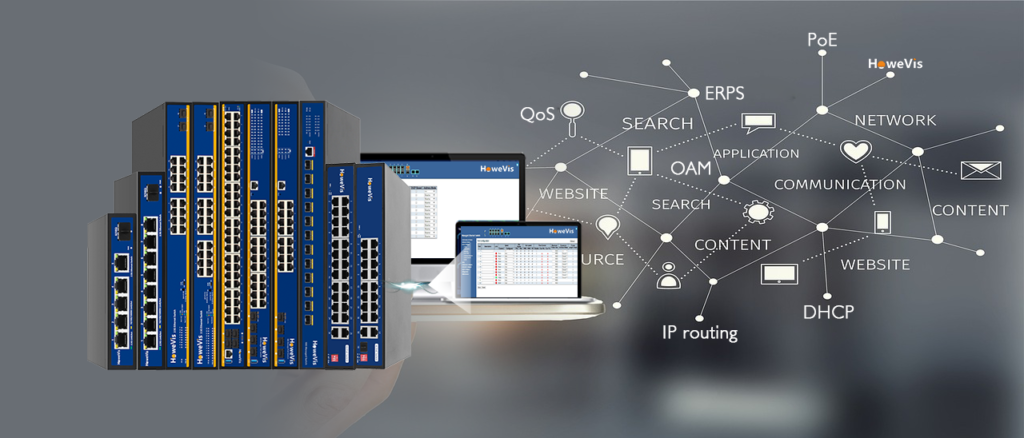

Choosing an industrial router used to be simple: select the required 4G band, add a SIM card, connect the PLC or camera, and bring the site online. That approach is no longer sufficient. Today’s industrial networks must support remote maintenance, multi-edge nodes, secure VPN tunnels, cloud integration, and private cellular slicing—all while maintaining strict power and cost budgets. In 2026, the Industrial Router RedCap category has emerged as the logical middle ground, yet it brings a critical engineering question: Is lightweight 5G enough for your specific remote failure modes?
I. Defining the RedCap Ecosystem: The Technical Middle Ground
5G RedCap (Reduced Capability) is the 3GPP Release 17 response to the “over-specification” of early 5G eMBB hardware. It is specifically designed for industrial IoT (IIoT) applications that require 5G’s low latency and network slicing but cannot justify the high cost and thermal complexity of full-tier 5G modules.
| Connectivity Type | Typical Position | Suitable Applications | Hardware Baseline |
|---|---|---|---|
| LTE Cat 1 / Cat 4 | Legacy IoT | Smart meters, basic telemetry, alarm panels | M2M Standard |
| LTE Cat 6 | High LTE Performance | Moderate industrial traffic, mobile office routers | Carrier Aggregation |
| 5G RedCap (HVT) | Optimized IIoT | AGVs, PLC controllers, sensors, remote gateways | 3GPP Release 17 |
| Full 5G (eMBB) | High Capacity | Ultra-HD Video, AI-Edge computing, large-scale sites | Sub-6GHz / mmWave |
II. Why Industrial Buyers are Moving to RedCap (And Why They Hesitate)
Industrial buyers are not choosing RedCap for the trend; they are performing a lifecycle cost calculation. A full 5G router can be excessive if the remote site only transmits controller messages, status data, or occasional telemetry. RedCap offers a “Right-Sized” approach, reducing initial device cost, power demand, and thermal footprints.

However, performance is not unlimited. If your site needs sustained multi-camera HD video uplink or local Edge-AI processing, the bandwidth limitations of RedCap modules—typically capped around 220 Mbps downlink and 120 Mbps uplink—might become a bottleneck. The real decision is not about speed, but about the Workload Profile.
III. Solving the “Zombie Online” Paradox: The HoweVis Engineering Approach
The most significant problem most router manufacturers ignore is the “Fake-Online” condition. This occurs when the cellular module is registered to the tower and the management platform shows a “Green” status, but actual application data forwarding has stalled due to internal dead-locks or EMI interference.
Hardware-Level Self-Healing (VWM Engine)
To address this, the HoweVis HVT-IR557 52X utilizes a staged recovery architecture that goes beyond simple software watchdogs.
- VWM (Virtual Man Watch): An independent hardware layer monitors the data bus. If it detects a logic lock where the module is non-responsive to AT commands, it triggers a physical circuit-level reset.
- Sliding-Window ICMP/TCP Probes: Unlike basic ping checks, the HVT series uses a sliding window of connectivity probes to distinguish between temporary network congestion and a genuine hardware hang.
- Sub-100ms Failover: In 2026, high-availability means hybrid networking. Our patented redial algorithm handles millisecond-level switching between 5G, Wi-Fi 7, and Wired Fiber.
IV. The HVT-IR557 52X Series: Full 5G Resilience
While RedCap is suitable for lightweight IoT, mission-critical infrastructure often demands a Full 5G Platform. The HVT-IR557 52X is designed for projects that require maximum interface versatility and uncompromising resilience.
| Operational Metric | RedCap Industrial Router | HoweVis HVT-IR557 52X (Full 5G) |
|---|---|---|
| Throughput (Peak) | ~220 / 120 Mbps | 3.4 Gbps / 350 Mbps |
| Interface Count | Minimal (2-port typical) | 5-Port Eth + Serial RS232/485 |
| Uptime (SLA) | Depends on firmware stability | 99.99% (VWM Hardware-Enabled) |
| Edge Computing | Basic logic only | Full Python SDK + OpenWRT Linux |
| Mean Time To Repair | 4-24 Hours (Manual intervention) | < 60 Seconds (Autonomous Recovery) |
V. Cybersecurity Architecture for OT Environments
Industrial equipment should never be exposed directly to the public internet. The HVT-IR557 52X acts as a hardened OT Security Boundary. It supports multi-layer encryption including IPsec, OpenVPN, L2TP, and GRE tunnels. More importantly, it features 15KV ESD protection and 3000V Surge immunity, ensuring that the router doesn’t become the weakest link during electrical storms or power grid surges.

VI. Edge Intelligence: The ROI of Python Secondary Development
In 2026, a router that only “forwards” is a cost center. A router that “thinks” is a value center. Through our **Python Secondary Development Platform**, engineers can aggregate Modbus data locally and only transmit “Alert” states to the cloud. This edge-processing logic can reduce monthly 5G data bills by up to **70%**, providing a clear path to project ROI.
VII. Factory Insight: The Source Manufacturer Advantage
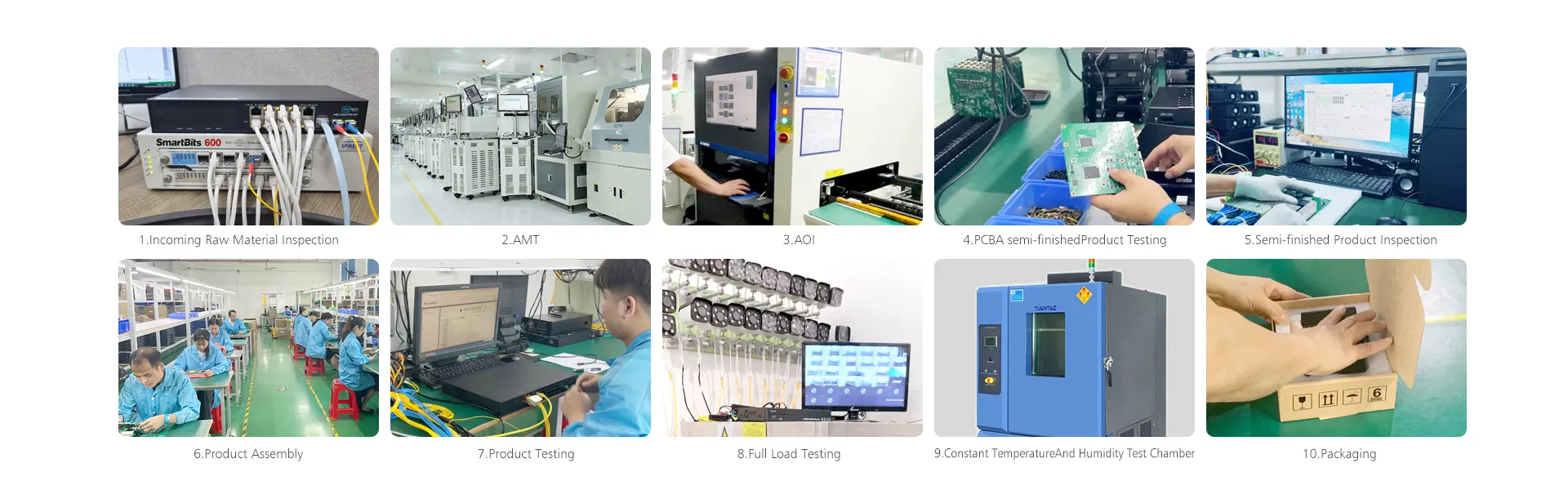
HoweVis is not a trader; we are an **Original Manufacturer**. Every HVT-IR557 52X unit is produced in our ISO-certified facility following a 15-step validation process.
- 3H/3W Design: High-heat, high-vibration, high-interference PCB engineering.
- Thermal Aging: 72-hour burn-in at 75°C to ensure component longevity.
- Global Bands: Customizable radio modules for private n78/n79 bands or specific national carriers.
Technical FAQ (B2B Context)
Yes. It is fully optimized for 5G SA networking, allowing for dedicated traffic priority lanes—essential for smart grid and autonomous AGV fleet coordination.
The series is fully compatible with the HoweVis Cloud DM platform, supporting batch configuration, remote OTA upgrades, and real-time VWM health telemetry.
Connect with a HoweVis Connectivity Engineer
Don’t select a router based on a buzzword. Send us your project requirements (Bands, Device Count, Temperature, Protocols), and our engineering team will provide a customized 5G/RedCap architecture report within 24 hours.
WhatsApp Systems Engineer Request HVT-IR557 Datasheet