
A machine stops at a customer’s factory. The operator can see an alarm, but the engineer who knows the control program is hundreds of miles away. Without remote access, even a straightforward diagnosis may require a service visit.
The same problem appears at pumping stations, treatment plants and distributed energy sites. Existing PLCs, RTUs and instruments continue to do their jobs, but maintenance teams have limited access to the information needed to troubleshoot them.
Replacing every controller is rarely the first step. Often, the more practical approach is to add a controlled network connection around the equipment already installed.
Industrial cellular routers can provide that connection. The challenge is choosing an architecture that supports the required maintenance tasks, works with existing devices and keeps access to the control network restricted.
Start with the Task, Not the Network Speed
“PLC remote access” can mean several different things. An engineer may need to view diagnostics, check operating values, investigate a fault or make an approved program change.
Those tasks should not all receive the same level of access.
Read-only monitoring is a useful starting point. Program downloads, parameter changes and firmware updates need additional checks, including compatibility testing, backups and a recovery plan. Some operations also require an authorized person at the machine.
Remote access should support maintenance—not bypass the site’s operating procedures. A VPN connection is only the beginning; the PLC engineering software and the complete network path still need to be tested.
PLC Programming and Modbus Integration Are Different Jobs
PLC remote maintenance and Modbus data collection often share a router, but they solve different problems.
Remote Engineering Access
For remote engineering work, the objective is to establish an approved connection between the engineer’s workstation and the controller, or a controlled engineering workstation at the site.
Compatibility depends on the PLC model, software version, addressing and communication requirements. Being able to reach a device over IP does not guarantee that every discovery or programming function will work through the connection.
Modbus Data Integration
Modbus integration is about moving device data into another system. Depending on the application, this may involve:
- Carrying serial data over an IP network.
- Converting Modbus RTU communication to Modbus TCP.
- Polling registers and publishing selected values through MQTT.
These functions are not interchangeable. A serial port provides a physical connection; it does not automatically provide register polling, data mapping or cloud integration. Likewise, serial transparent transmission is not the same as Modbus protocol conversion.robustel+1
Before selecting hardware, decide where the data-processing work will happen. It may run on a supported router application, a dedicated protocol gateway or an industrial computer.
Build the Connection Around Controlled Access
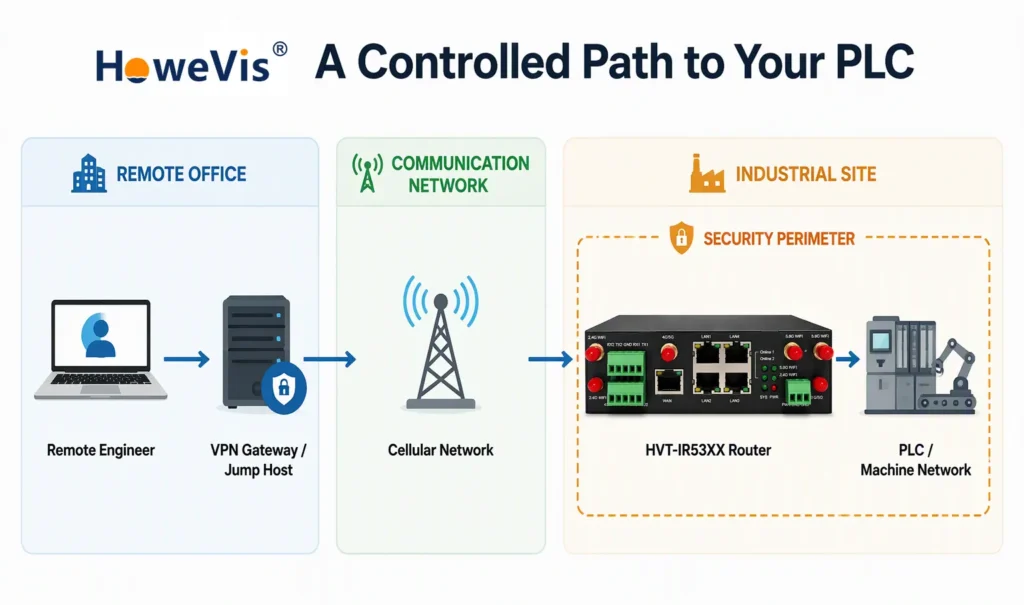
A practical remote-access architecture may look like this:
Authorized engineer → controlled VPN endpoint or jump host → cellular network → industrial router → restricted machine network → PLC
The router provides the field connection and helps define the network boundary. The wider system determines who can enter, what they can reach and which actions they may perform.
Account for Cellular Addressing
Cellular services may place devices behind private addressing or carrier-grade NAT. In that situation, an engineer may not be able to initiate a direct inbound connection to the site.
One option is for the field router to establish an outbound connection to a controlled VPN endpoint. The carrier service, VPN configuration and firewall rules must be verified together.
Avoid Direct PLC Exposure
Public port forwarding should not be the default method for reaching a PLC. Remote access should pass through a managed security boundary rather than expose the controller’s services directly to the internet.
Treat VPN Security as Part of the System
An encrypted VPN can protect traffic, but access controls and maintenance practices remain essential. Use individual accounts, multi-factor authentication at the access entry point, restricted permissions and connection logging. Keep both field equipment and remote-access infrastructure updated.
Protocol names also matter. GRE provides encapsulation, not encryption. L2TP should not be described as an encrypted connection unless its security arrangement—such as its use with IPsec—is specified.
Where 4G, 5G and RedCap Fit
The right cellular technology depends on the workload and the available network.
Periodic telemetry, interactive diagnostics, program transfers and video-assisted troubleshooting place different demands on a connection. Start with those requirements, then evaluate coverage, stability, throughput and service cost.
A higher advertised peak speed does not, by itself, make a remote maintenance session more reliable.
Standard 5G
Standard 5G is an option to assess where the project needs additional capacity or shares the connection with other services. Its usefulness still depends on local coverage, the selected module, supported bands and the end-to-end network.
5G RedCap
RedCap offers a lower-complexity 5G device path for applications that do not require the full capabilities of conventional high-performance 5G equipment. It should not be treated as an automatic guarantee of deterministic latency or ultra-reliable low-latency communication.
A RedCap deployment also requires confirmation of network support and device compatibility. General 5G coverage is not sufficient evidence that a particular RedCap configuration will work.
For either option, compare the complete deployment cost: hardware, antennas, data plans, VPN infrastructure and ongoing support. RedCap does not automatically reduce the amount of data produced by the application.
A Product to Evaluate: HoweVis HVT-IR53XX
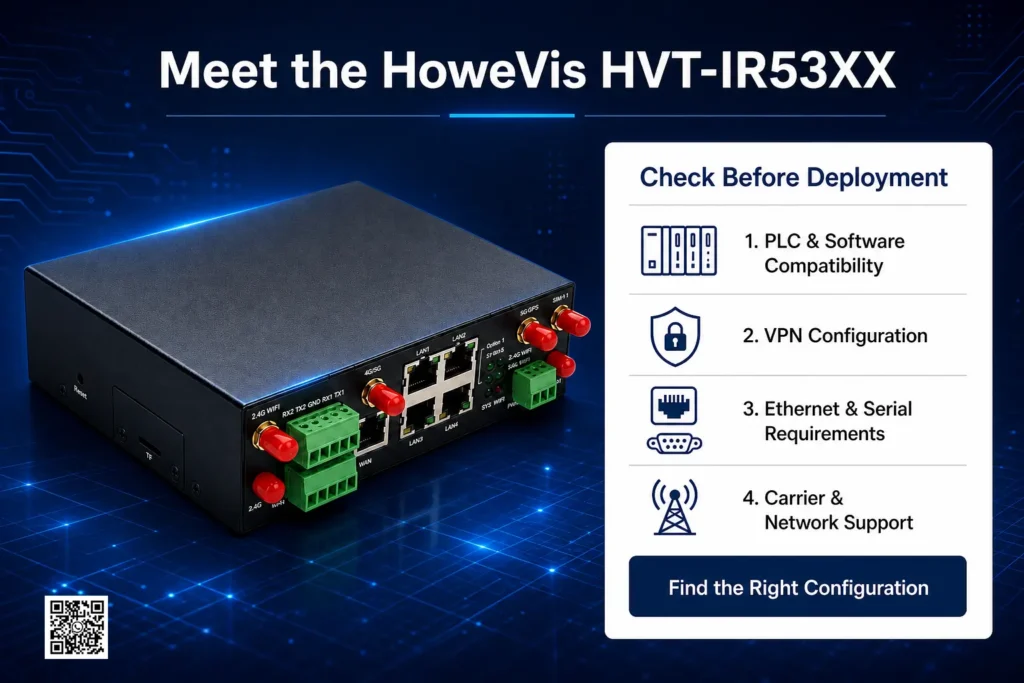
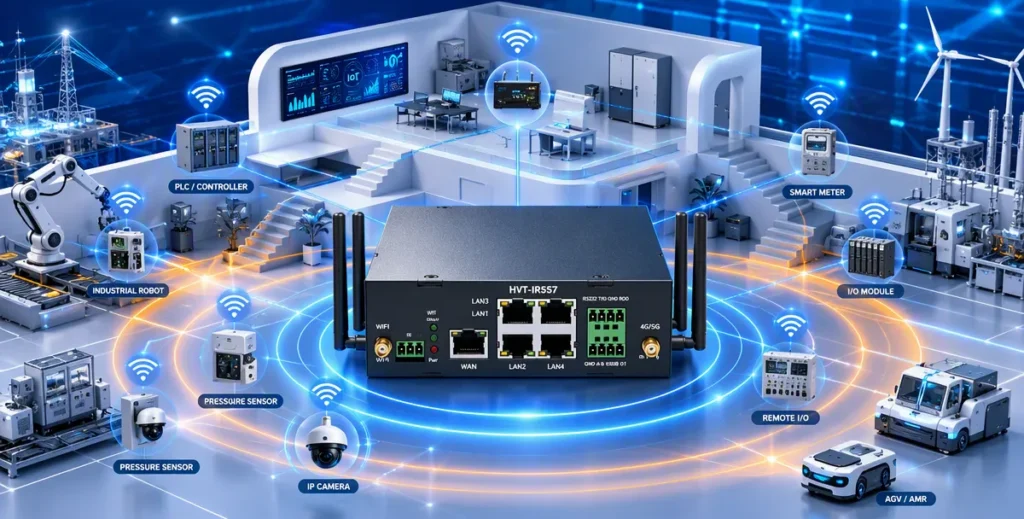
The published product description lists four Gigabit LAN ports, one Gigabit WAN port, RS232/RS485 interfaces and optional I/O connectivity. It also describes optional Wi-Fi, link backup, optional dual-SIM redundancy, automatic reconnection, VPN security and remote device management.
Ethernet and Serial Connectivity in One Platform
The Ethernet and serial interfaces provide connection options for sites containing both modern networked equipment and older field devices.
For PLC maintenance, verify the selected configuration’s VPN capabilities, routing behavior and compatibility with the engineering software. For Modbus integration, confirm the exact function required: serial transport, RTU-to-TCP conversion, register polling or MQTT publishing.
The product page refers to industrial protocol integration, but the project specification should identify the required software functions and firmware configuration rather than assume that every workflow is included.
Connection Backup for Distributed Sites
The series lists wired, cellular and Wi-Fi link backup, with dual-SIM redundancy available as an option.
These features are worth evaluating where loss of the primary connection would delay maintenance or data collection. However, backup connectivity should be tested under realistic conditions. Confirm how failure is detected, how the alternative link is selected and whether an active maintenance session needs to reconnect.
Do not assume that dual SIM means uninterrupted communication.
Installation Conditions Still Matter
The product description lists a metal enclosure, wide DC power input and IP30 protection.howevis
The final installation should be reviewed against the selected model’s specifications. Confirm the permitted operating temperature, power requirements and enclosure arrangement before placing the router in an outdoor cabinet or demanding industrial environment.
For this recommendation, the HVT-IR53XX should be treated as an industrial 5G router. Its product description does not establish a RedCap configuration, so RedCap remains a separate technology option to discuss with the engineering team.
Two Ways to Connect Legacy Modbus Equipment
The required protocol capabilities determine the architecture.
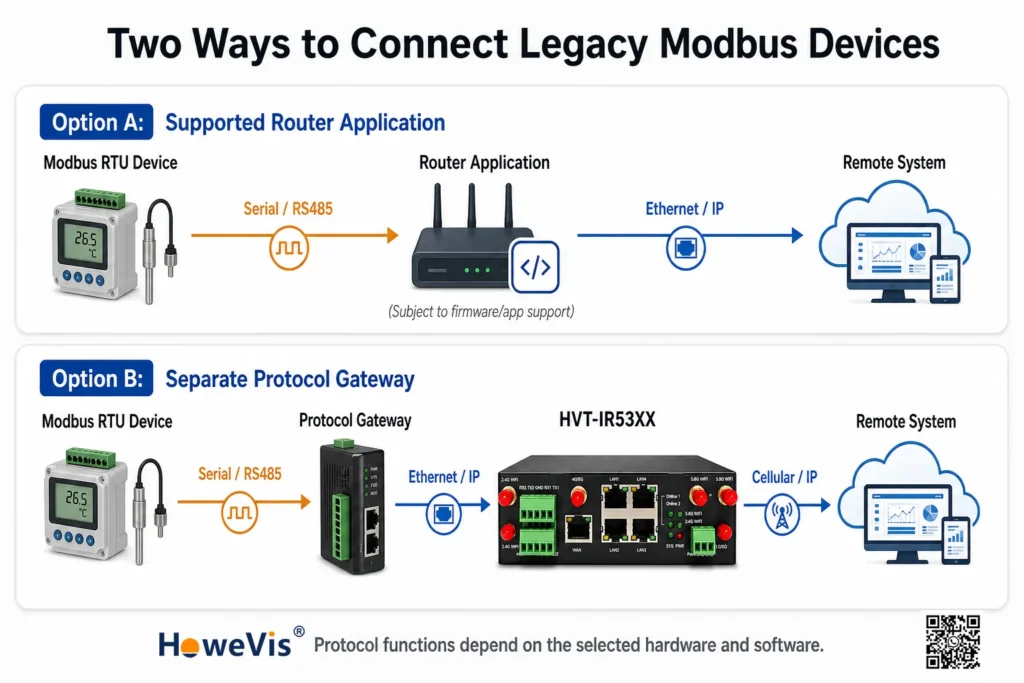
Option A: Processing on the Router
If the selected router configuration includes the necessary application, it may handle Modbus data collection or conversion before transmitting the results.
Modbus RTU device → serial interface → supported router application → cellular network → monitoring system
Confirm the supported devices, register configuration, message format and platform authentication before choosing this approach.
Option B: A Separate Protocol Gateway
If the router does not include the required processing functions, use a dedicated gateway or industrial computer.
Modbus RTU device → protocol gateway → Ethernet → industrial router → remote system
This separates data collection from network connectivity. A Modbus-to-MQTT workflow, for example, needs a component that reads and maps device values before publishing messages to an MQTT broker; the cellular connection alone does not perform that work.
What to Test Before Going Live
A useful acceptance test goes beyond checking that the router has internet access.
| Confirm the PLC model and engineering-software version. |
| Check addressing, routing and permitted services. |
| Verify the carrier connection and VPN endpoint. |
| Test read-only diagnostics before program changes. |
| Confirm access restrictions, logging and account revocation. |
| Simulate connection loss and test recovery. |
| Check backup-link behavior. |
| Validate approved program transfers during a maintenance window. |
| Document backup, recovery and on-site coordination procedures. |
For Modbus integration, test the actual register values and data representation as well. A successful network connection is not proof that the receiving system is interpreting the data correctly.