Industrial connectivity decisions are rarely about choosing the fastest network on paper.
A site manager may need to connect several IP cameras at a remote cabinet. A system integrator may need secure access to PLCs across dozens of customer locations. An OEM may be redesigning a machine that will remain in the field for eight or ten years. In each case, the question is not simply, “Do we need 5G?”
The real question is: what level of cellular connectivity makes technical and financial sense for this project?
Traditional LTE still serves many industrial applications well. Full-featured 5G delivers far more capacity than many field devices require. Between those two options is 5G RedCap, also called Reduced Capability NR or NR-Light.
5G RedCap was introduced through 3GPP Release 17 to support devices that need more than low-power wide-area connectivity but do not need the complexity of a full 5G broadband device. It is designed to reduce device complexity through narrower bandwidth use, fewer antenna paths, lower power consumption and relaxed performance requirements compared with full-capability 5G NR devices.
For industrial IoT, that positioning matters. RedCap can provide a more realistic path for industrial gateways, remote monitoring equipment, video security, mobile assets, controllers and connected machines that need reliable cellular communication without carrying the cost and power burden of high-end 5G hardware.
The Industrial Connectivity Gap
Industrial IoT does not operate in a clean laboratory environment.
Devices may be installed in electrical cabinets, substations, warehouses, pumping stations, construction sites, transport systems, solar fields, manufacturing lines or outdoor enclosures. They may be expected to run unattended for years. They may need to support legacy serial equipment, Ethernet devices, local switches, IP cameras and cloud applications at the same time.
That creates a gap between the main connectivity categories.
At one end, NB-IoT and LTE-M are useful for low-data sensors, periodic reporting and battery-oriented applications. At the other end, full 5G eMBB supports high throughput, complex networking and bandwidth-intensive applications. But many industrial projects sit between those two extremes.
They need enough capacity for real-time status data, remote access, moderate video traffic or multi-device aggregation. They also need reasonable equipment cost, manageable power use and a stable product lifecycle.
This is where 5G RedCap becomes relevant.
| Technology | Primary role | Typical fit | Main limitation |
|---|---|---|---|
| NB-IoT | Very low-data IoT | Metering, simple sensors, periodic reporting | Limited bandwidth and responsiveness |
| LTE-M | Low-power cellular IoT | Asset tracking, wearables, lightweight telemetry | Not ideal for higher-throughput gateways |
| LTE Cat 1 / Cat 4 | General-purpose cellular connectivity | Existing routers, remote access, basic monitoring | Long-term migration planning varies by market |
| 5G RedCap | Mid-tier 5G IoT connectivity | Industrial routers, video monitoring, gateways, mobile equipment | Requires compatible 5G SA network support |
| Full 5G eMBB | High-capacity 5G connectivity | High-bandwidth video, mobile broadband, advanced edge applications | May add unnecessary cost and complexity |
A well-designed industrial network does not use the most advanced radio technology everywhere. It uses the technology that matches the application, site conditions, maintenance model and expected service life.
What Makes 5G RedCap Different?
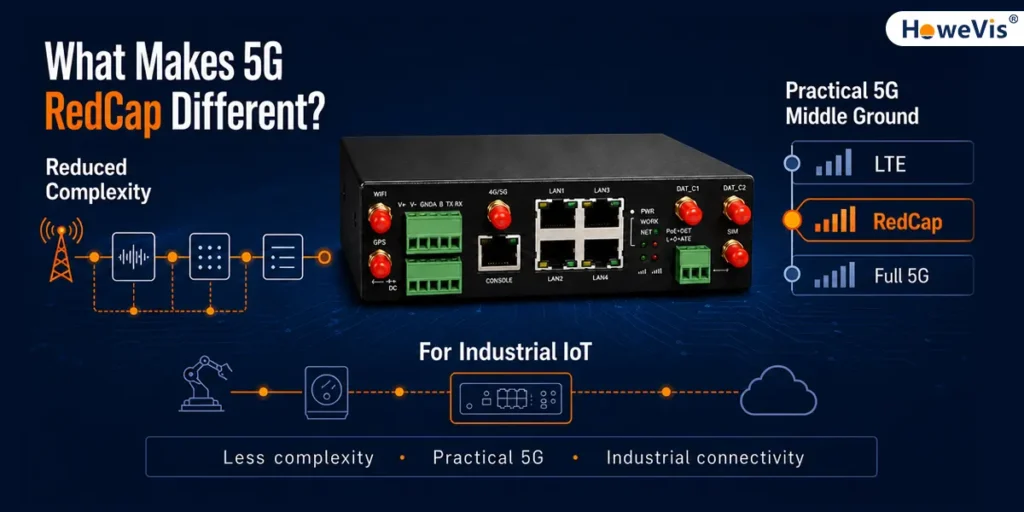
RedCap is not simply a slower version of 5G. It is a defined category of 5G NR device capability.
The objective is to make 5G more practical for devices that do not need the full radio complexity of smartphones, fixed wireless access equipment or high-end mobile broadband terminals. Release 17 RedCap reduces selected hardware and protocol requirements while maintaining access to the 5G NR ecosystem.
In practical terms, RedCap devices can use reduced bandwidth, fewer receive or transmit paths and less demanding processing capabilities. This allows module and terminal designers to reduce radio complexity and, in many cases, power consumption and bill-of-material pressure.
For a buyer, the important takeaway is straightforward:
RedCap is intended for applications where LTE may no longer be the preferred long-term platform, but full 5G is more capability than the site actually needs.
That does not mean RedCap is automatically the right answer for every industrial project. A low-data sensor may still be better served by NB-IoT or LTE-M. A high-resolution multi-camera installation may need full 5G capacity or fiber. A legacy project may continue using LTE for years.
But for a growing number of industrial applications, RedCap offers a useful middle ground.
Why TCO Matters More Than Peak Speed
When procurement teams compare industrial routers, they often start with the unit price. That is understandable, but unit price alone does not reflect the cost of operating a distributed industrial network.
The actual total cost of ownership includes:
- Initial equipment and module cost
- Site installation and commissioning
- SIM and data-plan management
- Power consumption
- Truck rolls and field maintenance
- Remote configuration and firmware updates
- Network downtime and lost visibility
- Replacement hardware and recertification
- Migration work when network conditions change
In a pilot deployment of five devices, a small difference in router cost may not matter much. In a rollout of 500, 2,000 or 10,000 devices, that difference can become material. The same is true for remote management: saving one unnecessary site visit per device can change the economics of an entire project.
That is why RedCap should be evaluated as an architecture decision, not a feature checklist item.
A lower-complexity 5G device can make sense where the project needs an upgrade path beyond older cellular platforms but does not need a premium full-5G router at every location. The value comes from selecting the appropriate capability level for each device class.
Industrial Sites Need Uplink, Recovery and Control
Consumer network marketing usually focuses on download speed. Industrial deployments often care about different things.
A remote monitoring site may upload camera footage, alarm records, sensor data and diagnostic logs. A maintenance engineer may need secure remote access to a PLC or HMI. A utility operator may require reliable communication with distributed field equipment. A system integrator may need to monitor the health of hundreds of installed devices from one platform.
For these use cases, the priorities are often:
- Stable uplink capacity
- Network availability at the installation site
- Automatic link recovery after a carrier or power event
- Secure remote access
- Compatibility with local industrial interfaces
- Visibility into device status
- Remote configuration at scale
An industrial 5G RedCap router should therefore be evaluated as more than a modem. It should work as a field network node: connecting local equipment, managing WAN connectivity, supporting secure communication and reducing the operational burden of distributed deployments.
A Real-World Deployment Scenario
Consider a remote electrical cabinet used for monitoring and control.
The cabinet may contain an IP camera, a small Ethernet switch, an industrial controller, an environmental sensor and a power supply. There may be no fixed broadband connection at the site. A technician may visit only when an alarm occurs, which makes remote visibility essential.
The system needs to do several jobs at once:
- Connect field equipment to a cloud platform or SCADA environment
- Upload monitoring data and selected video streams
- Allow authorized engineers to access equipment remotely
- Keep local devices connected during temporary network interruptions
- Provide power and network connectivity for selected IP devices
- Reduce the number of on-site service visits
In this situation, the right question is not whether the router supports the highest advertised 5G speed. The right questions are:
- Does the carrier support the required 5G SA and RedCap configuration at this location?
- Is the available uplink sufficient for the selected camera resolution and data volume?
- Does the router provide the required Ethernet, serial, PoE or I/O interfaces?
- Does the project need dual-SIM backup or LTE fallback?
- Can the device be monitored, configured and updated remotely?
- Can the hardware handle the site’s temperature, power and installation conditions?
That is a more useful buying framework than comparing a single throughput number.
Where 5G RedCap Fits Best
Industrial Gateways and Legacy Equipment Upgrades
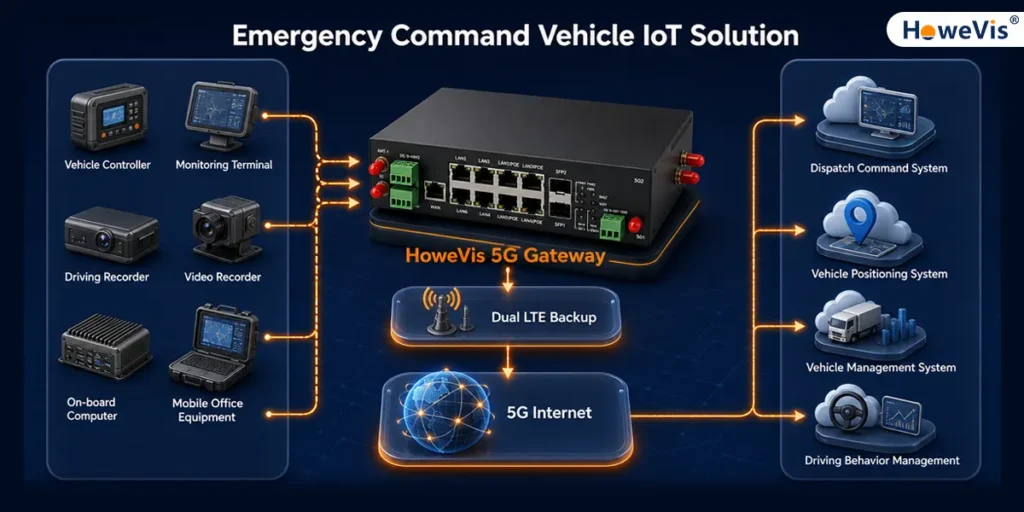
Many industrial sites still rely on PLCs, RTUs, HMIs, serial meters and local controllers. These devices may not need massive bandwidth, but they need dependable IP connectivity and secure remote access.
A 5G RedCap industrial router can bridge local Ethernet or serial equipment to a cellular WAN, allowing organizations to modernize communications without redesigning every connected asset.
For system integrators, the most relevant functions are often not radio specifications alone. They include support for Ethernet, RS232, RS485, Modbus TCP/RTU, MQTT, VPN services, firewall policies, scheduled reboot, watchdog recovery, dual-SIM behavior and remote device management.
Remote Video Monitoring
Security and operational video are common RedCap use cases because they often need more capacity than low-power IoT technologies can provide, but they do not always need the cost structure of a high-end full-5G deployment.
Typical locations include temporary construction sites, storage yards, remote access roads, pumping stations, solar farms, outdoor equipment areas and mobile work zones.
However, video projects should always begin with a traffic calculation. Camera count, codec, frame rate, resolution, event recording, storage approach and expected uplink capacity all influence the design. RedCap can be a good fit for moderate video workloads, but it should not be positioned as a universal replacement for fiber or high-capacity 5G.
Utilities and Distributed Infrastructure
Energy, water and environmental monitoring projects often have long operating cycles and widely distributed assets. A device deployed at a solar inverter station, water-treatment site, pipeline cabinet or distribution panel may be difficult and expensive to access physically.
For these projects, the value of a cellular router often lies in remote diagnostics and predictable maintenance, not only data delivery. A practical design may require industrial temperature tolerance, power-input flexibility, VPN access, dual-SIM resilience, remote firmware management and clear documentation for long-term service support.
Smart Manufacturing and Edge Connectivity
In factory environments, RedCap may support status reporting, material movement systems, production monitoring, selected AGV communications and edge device connectivity where wired infrastructure is difficult or expensive to extend.
The key is to separate applications by criticality. A plant should not assume that every wireless task has the same latency, reliability or safety requirement. High-criticality motion control, safety systems and time-sensitive processes require their own engineering assessment. RedCap is better positioned for the broad layer of industrial IoT communications that needs reliable, moderate-capacity connectivity.
RedCap, 5G SA and LTE Fallback
One of the most important points in any RedCap project is network readiness.
RedCap is a 5G technology and depends on compatible network support. A location having “5G coverage” does not automatically mean that RedCap devices will operate as expected. The available network mode, carrier implementation, frequency bands, device firmware and subscription profile all matter.
Before selecting hardware, project teams should confirm:
- Whether the target operator supports 5G Standalone for the intended deployment
- Whether RedCap device support is available in the relevant market and bands
- Which frequency bands the router and module version support
- Whether LTE fallback is required during a transition period
- Whether the planned application depends on specific uplink, latency or private-network capabilities
- Whether the SIM, APN and enterprise security model are compatible with the deployment
It is also important to separate RedCap capability from LTE fallback capability.
RedCap is a 5G NR device category. LTE fallback is a product-level capability determined by the modem, firmware, supported bands and router design. For many industrial deployments, a multi-mode router that supports both the required 5G configuration and LTE operation can simplify the transition strategy—but only when it has been validated for the target carrier and country.
Choosing an Industrial 5G RedCap Router
A product page that only says “5G RedCap router” does not give an engineering team enough information to make a decision.
The router needs to fit both the network and the field cabinet.
| Selection area | What to check | Why it matters |
|---|---|---|
| Carrier compatibility | SA availability, RedCap support, frequency bands, SIM requirements | Determines whether the device can connect in the target market |
| Cellular continuity | LTE fallback, dual SIM, failover logic, link monitoring | Supports continuity during network or SIM issues |
| Local interfaces | Ethernet, serial, I/O, Wi-Fi, GNSS, USB | Determines compatibility with field equipment |
| PoE capability | Port count, PoE/PoE+ budget, power input | Important for cameras, access points and IP devices |
| Security | VPN, firewall, APN support, user access control | Protects remote access and industrial data paths |
| Remote management | Monitoring, alerts, configuration backup, firmware updates | Reduces maintenance time across large fleets |
| Industrial design | Operating temperature, enclosure, mounting, EMC and power tolerance | Determines suitability for the actual installation environment |
| Lifecycle support | Documentation, supply continuity, technical support, certifications | Reduces long-term project risk |
HoweVis HVT-IR93XX for Industrial Edge Connectivit
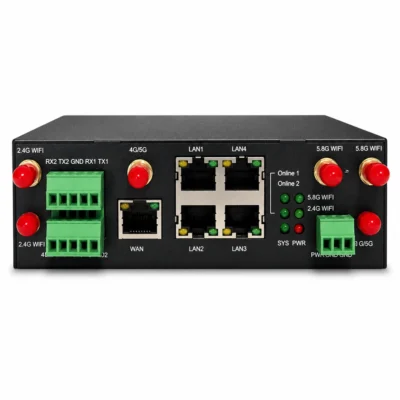
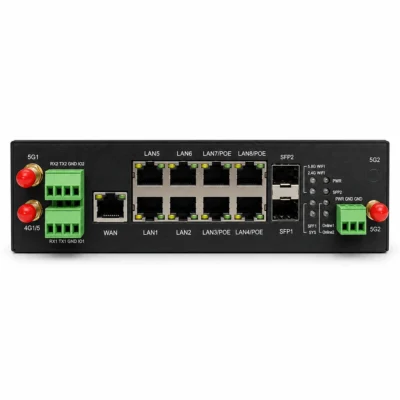
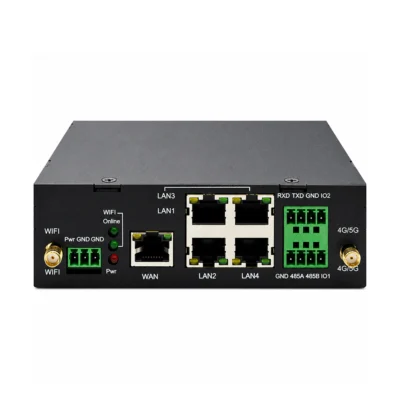
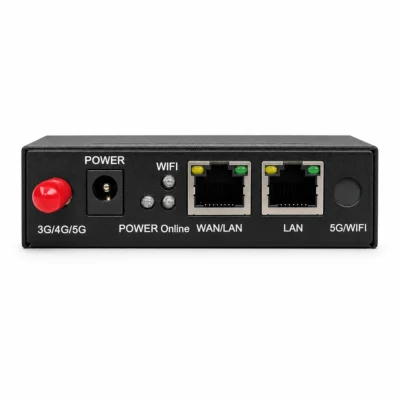
The HoweVis HVT-IR93XX 5G RedCap Industrial Router is designed for projects where local network aggregation and cellular backhaul need to be handled in one industrial device.
Rather than treating RedCap as a standalone selling point, the HVT-IR93XX is intended for the practical conditions seen in field deployments: local devices require Ethernet connectivity, IP endpoints may need PoE power, remote locations may lack fixed broadband, and operations teams need a manageable way to connect distributed assets.
This makes the platform relevant to applications such as:
- Industrial control cabinets and PLC connectivity
- Remote SCADA and RTU communications
- IP camera backhaul and site security
- Smart-energy and utility monitoring
- Outdoor cabinets and distributed infrastructure
- OEM equipment networking
- Temporary site connectivity
- Edge gateway deployments with multiple local IP devices
For an integrator, the benefit is not simply adding a 5G connection. It is reducing the number of separate devices required in the cabinet and creating a clearer architecture for local networking, cellular WAN access and remote maintenance.
Actual project suitability should always be confirmed against the required carrier bands, PoE power budget, device count, VPN policy, environmental conditions and local regulations.
A Better Procurement Conversation
A good RedCap project starts with operational questions, not product slogans.
Instead of asking only, “What is the price of a 5G RedCap router?”, a procurement or engineering team should define:
- The country and mobile operator
- Whether 5G SA is available at the actual installation locations
- The number and type of devices connected at each site
- Required Ethernet, serial, PoE and I/O interfaces
- The expected monthly data usage
- Uplink needs for video, alarms and diagnostics
- Security requirements for remote access
- Whether LTE fallback is needed
- Operating temperature and power conditions
- Fleet-management requirements for deployment and support
With those inputs, it becomes easier to determine whether RedCap, LTE, full 5G or a mixed architecture is the right choice.
Plan the Network Before You Scale
5G RedCap gives industrial IoT teams a practical option between low-data cellular technologies and full-capability 5G. Its value is not that it is automatically cheaper, faster or better in every situation. Its value is that it gives project teams another capability tier to use when LTE is no longer the preferred long-term answer and full 5G would be excessive.
For industrial gateways, remote monitoring, moderate video applications, PLC and SCADA connectivity, and distributed infrastructure, the right RedCap router can support a more balanced approach to performance, hardware cost and long-term operations.
If you are planning a cellular upgrade for an industrial IoT project, share the deployment country, target carrier, required interfaces, connected device count, data profile and environmental conditions with the HoweVis team.